


Stacking Tower: 12 Play Ideas That Grow With Your Child
In Brief
- A stacking tower is not a one-day toy – it accompanies children from 18 months for years.
- Stacking Fun (without small parts): from 18 months, ideal for first stacking and colors.
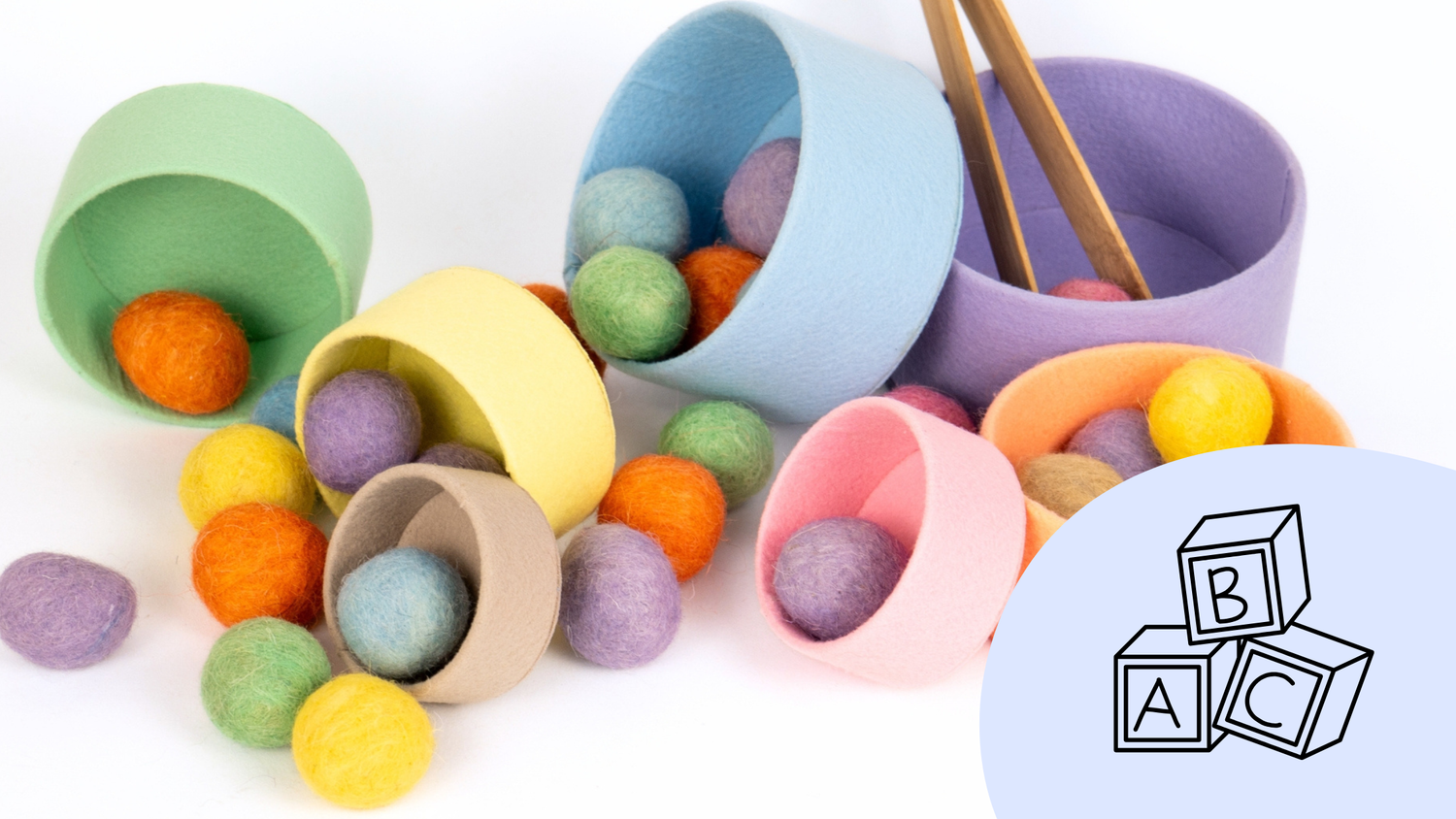
- Rolling Fun (with felt balls & wooden tweezers): from 3 years, for sorting, pincer grasp, and imaginative play.
- The play ideas below are staggered by age – just choose the right level.
- Developed together with occupational therapist Silvia Resei (@ergotipps) – and now also in soft pastel.
"What do you actually do with it – besides stacking?" We hear this question often. And the answer is: an astonishing amount. A stacking tower is one of those toys that are so valuable precisely because they don't prescribe anything. They adapt to what your child can do and wants to discover at any given moment.
Here are twelve ideas – from the first wobbly tower to an imaginative landscape. And they don't stop being fun as soon as your child gets "too big": they simply change with them.
First: Which variant suits your child?
We deliberately offer the stacking tower in two variants – and that has a safety reason:
🟡 Stacking Fun – from 18 months The six soft felt bowls in rainbow colors, completely without small parts. This allows even the youngest to play safely: stacking, nesting, discovering colors.
🌈 Rolling Fun – from 3 years The bowls plus 28 color-matching felt balls and wooden tweezers. The balls open up completely new play possibilities – sorting, matching, grasping with a tool. Because small balls pose a choking hazard for younger children, we recommend this variant only from three years of age.
Honestly, we would have preferred to offer everything in one product. But safety comes first. That's why we prefer two honest variants to a compromise.
New: now also in pastel. Both towers are available in cheerful colors and – new from August – in soft pastel. Simply select your favorite color world on the product page.
Developed with an occupational therapist. We developed the stacking tower from the beginning together with Silvia Resei – an occupational therapist known on Instagram as @ergotipps. Her professional perspective is in every detail: from the size of the bowls to the weight of the balls to the wooden tweezers that train the pincer grasp just right. Not a random design, but well-thought-out toys with real developmental benefits.
Play ideas from 18 months (Stacking Fun & Rolling Fun Bowls)
1. The first tower. Sounds trivial, but it's not: placing bowl on bowl requires concentration, a sense of balance, and steady hands. And the moment it topples over is part of the game.
2. Nesting. All bowls nested by size. Your child learns about size relationships – "does this fit in or not?" – almost incidentally.
3. Naming colors. "Where is the red bowl?" – a simple game that strengthens vocabulary and color recognition.
4. Hide & Seek. Place something under a bowl and have them find it. A classic that also trains the understanding that things continue to exist even when you can't see them.
5. Drumming. Turned upside down, the bowls become quiet little drums. Rhythm, cause and effect – and a little noise that doesn't annoy anyone.
6. Transferring. Fill and empty with pasta, beans, or building blocks. One of the most popular Montessori exercises ever.
Play ideas from 3 years (Rolling Fun with Balls & Tweezers)
7. Sorting colors. Each felt ball goes into the color-matching bowl. This trains color recognition, concentration, and logical thinking – you can read why this is so valuable in The Art of Sorting.
8. The pincer grasp. Grasping and moving the balls with the wooden tweezers. This specific movement was particularly important to Silvia Resei: it's the direct precursor to holding a pencil later. More exercises on this in Promoting Fine Motor Skills.
9. Counting & Quantities. "How many blue balls are there?" First experience with quantities, without number cards.
10. Creating patterns. Red – blue – red – blue. Who continues the sequence? Pattern recognition is an important precursor to mathematical thinking.
11. Stacking Challenge. How high can it go before it falls? Which order holds best? Problem-solving with immediate feedback.
12. Imaginative landscapes. The bowls become mountains, caves or houses, the balls become treasures, eggs or inhabitants. Here the "learning toy" stops and free play begins – and that is precisely the most valuable thing.
Why a stacking tower remains exciting for so long
The secret lies in the fact that it prescribes nothing. It doesn't blink, it doesn't make sounds, it has no "right" solution. An 18-month-old child stacks. At three, they sort. Later, they invent entire worlds from it – and some children still build landscapes with it in elementary school.
This is exactly what we mean when we say: a good toy grows with you. There is no expiry date – just new ways to play with it. Instead of three toys that become too simple one after the other, one accompanies you for years.
A tip for the end: Put the tower away for two weeks every now and then. When it reappears, it seems almost new – and your child discovers it differently with their new skills.
Curious? Discover Stacking Fun for the youngest from 18 months and Rolling Fun with balls and tweezers from 3 years – both handmade from soft felt.

Leave a comment
All comments are moderated before being published.
This site is protected by hCaptcha and the hCaptcha Privacy Policy and Terms of Service apply.