


Child Development 12–18 Months: Playful Promotion of Fine Motor Skills, Language & Everyday Life
In brief
- Movements become more precise, the desire for independence grows noticeably.
- Children imitate everyday actions and begin to understand connections.
- Vocabulary expands, first word combinations emerge.
- Small challenges motivate – without overwhelming.
Between twelve and eighteen months of age, children develop rapidly. Movements become more precise, the desire for independence grows, and the world is not only explored but increasingly understood. Children begin to recognize connections, imitate processes, and actively shape their environment.
In this phase, calm, well-thought-out play impulses support your child's development – by playfully fostering fine motor skills, perception, language, and early logical thinking.
What happens between 12 and 18 months?
Children at this age increasingly connect movement with thinking. Hands are used purposefully, small tasks are consciously repeated, and simple problems are solved independently.
Typical developmental steps in this phase are:
- more precise gripping, inserting, and pulling
- first rotating and buttoning movements
- imitation of everyday actions
- growing vocabulary and first word combinations
- longer concentration phases
- increasing self-confidence ("I want to do it myself")
Fine motor skills, patience, and endurance now develop significantly. At the same time, the need to name things, categorize them, and embed them in small stories grows.
How educational toys meaningfully support development
Educational toys can now become a little more complex. Small challenges foster the motivation to engage with something for longer – without causing frustration.
Meaningfully designed educational toys support:
- fine motor skills and finger strength
- concentration and endurance
- logical thinking
- language development
- creative play and imagination
Play opportunities that combine motor exercises with free play and allow room for individual ideas are particularly valuable.
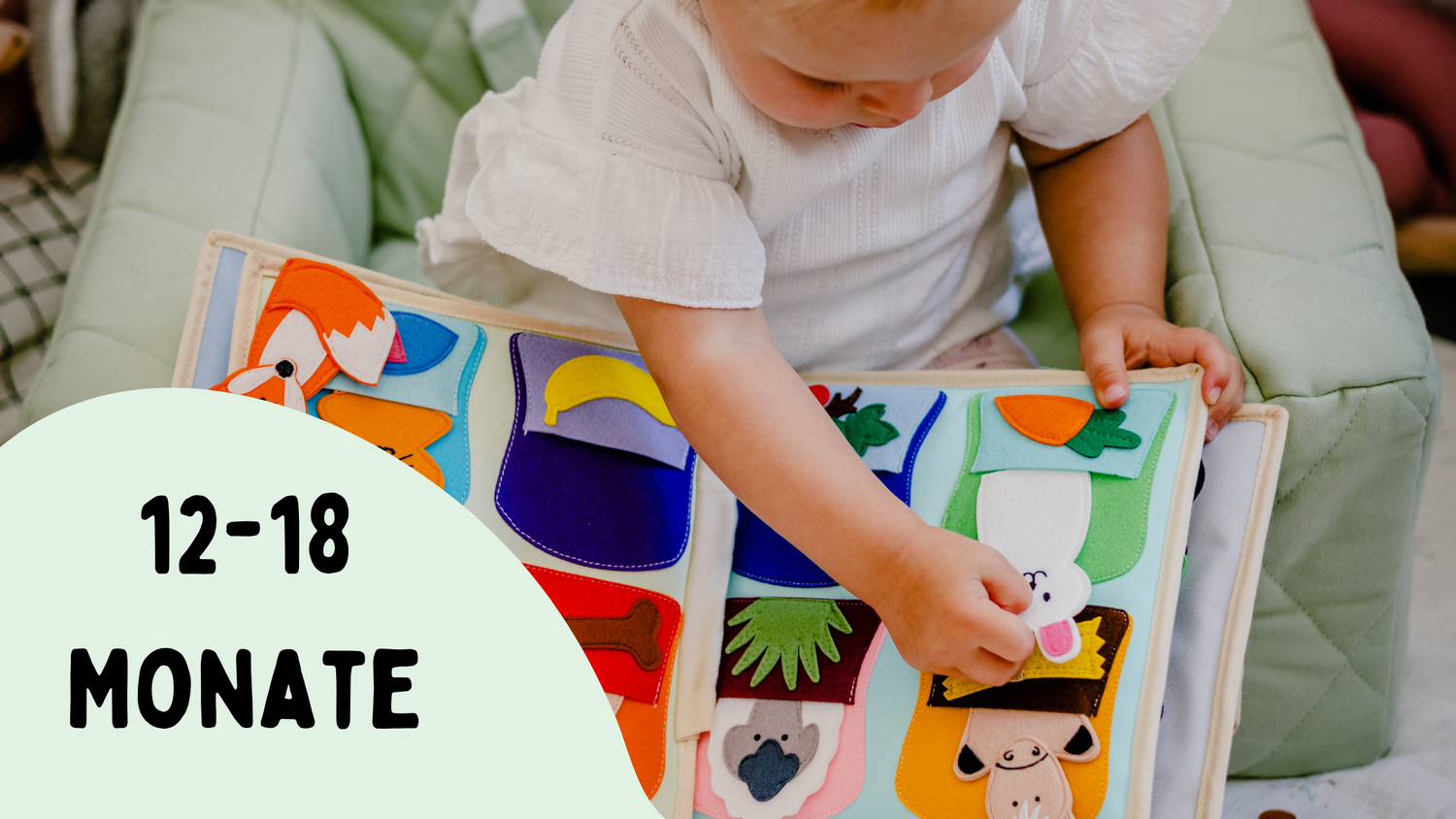
Recommendation for 12–18 months: Quiet Book Pastel "Young Owl"
The Quiet Book Pastel "Young Owl" is a lovingly handcrafted fabric book that invites children from around 12 months on a colorful journey of discovery. Each page offers new small tasks that playfully motivate participation.
With colorful shapes, a cheerful ladybug with a zipper, funny finger puppets, and a rainbow for buttoning, the book combines targeted motor exercises with creative play.
This promotes:
- fine motor skills and dexterity
- patience and concentration
- playful learning of colors and shapes
- imagination and language through small stories
It's exactly the right companion for the phase when children want to become active, understand processes, and grasp their environment.
Simple play ideas for 12–18 months
1. Opening & Closing. Zippers, buttons, or flaps are discovered together. Your child tries, repeats, and perfects the movements. Fosters: Fine motor skills, patience, self-confidence. Find more exercises in Promoting Fine Motor Skills.
2. Naming & Storytelling. Figures, colors, and shapes are named together. Small stories are created around the motifs. Fosters: Language development, vocabulary, imagination. More on this in Promoting Language Development.
3. Imitating everyday situations. Dressing, sorting, or simple sequences of actions are playfully reenacted. Fosters: Understanding of everyday life, logical thinking, independence.
The most important thing at the end
In this phase, children learn by trying, repeating, and understanding. Playful challenges build confidence in their own abilities – and lay the foundation for independent learning.
And if your child wants to close the same button for the tenth time: Let them. That's exactly where the learning happens.
Back to Baby Development 6–12 Months · Continue to Child Development 18–24 Months

Leave a comment
All comments are moderated before being published.
This site is protected by hCaptcha and the hCaptcha Privacy Policy and Terms of Service apply.